Mami, a second Amma in my life

Amma (mom) is extremely special for every one of us. This post is not to tell you why moms are special but to articulate how blessed I have been in my life to have my beloved Amma and Mami, a mother-like figure in my life. Parvathi Mami (Mami means aunt) has been in my life since I was born. To the outside world, she was our live-in cook but that word does not do her justice and is a real disrespect to her impact on our lives and the relationship we had over decades.

If Amma means unconditional love, Mami is certainly a second mother to me. She called me Ammu as a term of endearment. While my brother R was certainly her favorite, she loved us all unconditionally. Mami and I had our own bond – I used to hangout in the kitchen helping her with miscellaneous tasks (edupidi velai), ran to the market to get anything she needed last minute, served as the resident taster before food left the kitchen, and went for movies with her. Mami’s life was so busy when we were kids. She would get six lunch bags ready for the six kids by 8:30 am, I would help fill six water bottles, and check that spoons were in etc. I also remember helping her make sevai and she would always keep maavu (steamed rice flour) for me since I loved it. When I had congestion, she would force me to do aavi (steam) till I was sweating profusely and she was satisfied with the outcome. She used to make us a school day breakfast of paruppu saadam (lentil rice) with getti thayir (yogurt) with lots of ghee which still is my comfort food. I never like/liked to be babied by anybody but Mami was one exception – I never minded when she insisted on treating me like a kid since it made her happy.

Mami became a widow very early in her life and joined our family about five years before I was born. During the thousands of hours we spent in each other’s company, Mami reminisced with me about her formative years, her husband, and her family in Chidambaram. She lost her niece who she was very close to when the niece was in her late teens and she spoke about her to me. As a thirteen year old girl myself, I never knew what to say to make her feel better; but I realized that just listening to her seemed to be enough. I just hugged her hoping that the hug conveyed what I felt.

On the lighter side, Mami also invited me to be the judge in the mini skirmishes that happened with the other people that helped around the house -watchman, office people etc. She would ask me if the way she had reacted to a situation was right or not. And I did my best in being fair without hurting her feelings.

When my college friends visited me last year, they also remembered the amazing mixed rice (ellu saadham and thayir saadham) Mami packed for our two day train travel from Madras to Delhi. Not to mention the various rice powders (paruppu podi, thenga podi) and pickles Mami packed for me and my friends. She was Annapurni-incarnate (Hindu goddess of food and nourishment).

Mami was fiercely loyal to Amma and stood up to anyone who she felt slighted Amma. In this, we were so alike. When our joint family existence came to an end and our family moved away, Mami continued to stay with the nucleus of the joint family for a few months before she joined us. During those months, Mami often came to our school to see us and check in on us. My heart leapt when I saw her.

When Amma passed away, I know that her presence added a lot of stability to our household where Appa and R were alone. For that and all that Mami is/was to us, I am forever indebted to her. I have not been in close touch with her for over two decades since I moved to the US and daily life took over but think of her often. I believe that the bonds formed in those formative years holds strong even today when I think of her.

When she passed away almost a year ago, a piece of my childhood was forever gone. All I could hope was that she was reunited with her niece and is living happily in the other-world.

Untethered book consumption

Source: Crismatec

Books are my first love, a forever friend. It has always been this way for as long as I can remember. When in school and then college, I had the luxury of time. I could choose to stay up late to read a good book and sleep in the next morning. I could lose myself in the real or fictional characters, their lives and unique journeys, without a care in the world. My dream house always had a reading room with wall-to-wall wood paneled book shelves with neatly arranged books. It also had a reading corner with a cozy spot to sit and a warm blanket to truly get comfortable. A girl can dream right?

While my love for books never diminished, the time that I could allocate for that activity was greatly reduced with work, and more generally adulting activities. I went from reading a hundred books in a year to counting myself lucky if I could finish even five books in a year. I told myself that reading the TIME magazine counted but who was I kidding.

After we had kids, it became even more difficult to make time and kids became my number one priority. Between taking care of kids, work, household chores, driving to and from work and kids activities, sleep and exercise there was not that much free time left. And what little free time I had, I would rather spend with K and the kids than do anything else. So, reading books became a thing that I did in the past.

All this changed about two years ago. I now average about 30 books a year! My days did not magically have more hours though that would be awesome. I discovered Audible. I was initially resistant to the new modes of book consumption – kindle, audible etc. One of the reasons for my resistance was that I felt it was a betrayal to old school reading. But after trying it, I am now a true convert. Listening to a reader read a book does not equal the joy I get from holding a real book in my hand and reading it. That magic is special. But it is pretty good. And more importantly I am actually consuming a good number of books.

Source: Inicases.com

I can listen to Audible at any time – while picking up groceries, food prep, exercising, cleaning, driving..the opportunities are endless. I do have to rewind the audio sometimes if I was not paying attention and missed something but 90% of the time, I retain what I listen. And my phone is with me all the time which means I have all my books with me all the time and hence I call it untethered book consumption. It can hold more books than any wall to wall bookshelf I could have had. And I do not have to deal with heavy book boxes the next time we move!

And having books in my life again make me happy. Isn’t that one of the core things we pursue in life – happiness?

What makes you happy my friend?

Freedom..not a simple meaning at all

Freedom is usually defined as having the ability to act or change without constraint. But I think in real life, there is a more nuanced meaning for that word.

A few years ago, my friends and I were talking about career paths post graduation. A friend of mine said she is planning to be a stay-at-home-mom for a few years which prompted a lot of unsolicited but well-intentioned advise from the group on why she should not do it. After all, we have spent years (not to mention many thousands of dollars) on education with the unsaid goal of building a successful corporate career. Then, one person said that she cannot believe that someone in this day and age would even consider staying home; and that such decisions are a betrayal of the Feminism movement. That comment made me pause because the outcomes of the Feminism movement is not/should not be asking an entire generation of women to be beholden to a new set of rules and expectations i.e. one that says women should pursue careers; women should choose career over kids. Does that outlook not undermine the very basic tenet of the feminism movement?

I remembered that conversation this past weekend. I am reading (rather listening to) the book – The Water Dancer by Te-Nehisi Coates which traces the story of a young black man, Hi, who discovers that his memories trigger a mysterious power of teleportation that can help slaves escape to the North to be safe. In it there is a conversation between him and a character called Sophie, shown below:

“But freedom, true freedom, is a master too, you see—one more dogged, more constant, than any ragged slave-driver,’ she said. ‘What you must now accept is that all of us are bound to something.  Some will bind themselves to property in man and all that comes forthwith.  And others shall bind themselves to justice.  All must name a master to serve.  All must choose”

That line of thought encapsulates freedom to me. Freedom is not about being unshackled from anything and anyone. Freedom is about choice, your choice. Not society’s choice for you (also called norms), your family or friend’s choice for you (termed as expectations), but your choice – loud and clear. At the end of the day, we are all bound to something but we get to choose what and who we are bound to and how.

Do you agree with this more nuanced but simple meaning of freedom?

Three’s a crowd in any relationship even if one of the party is a machine..

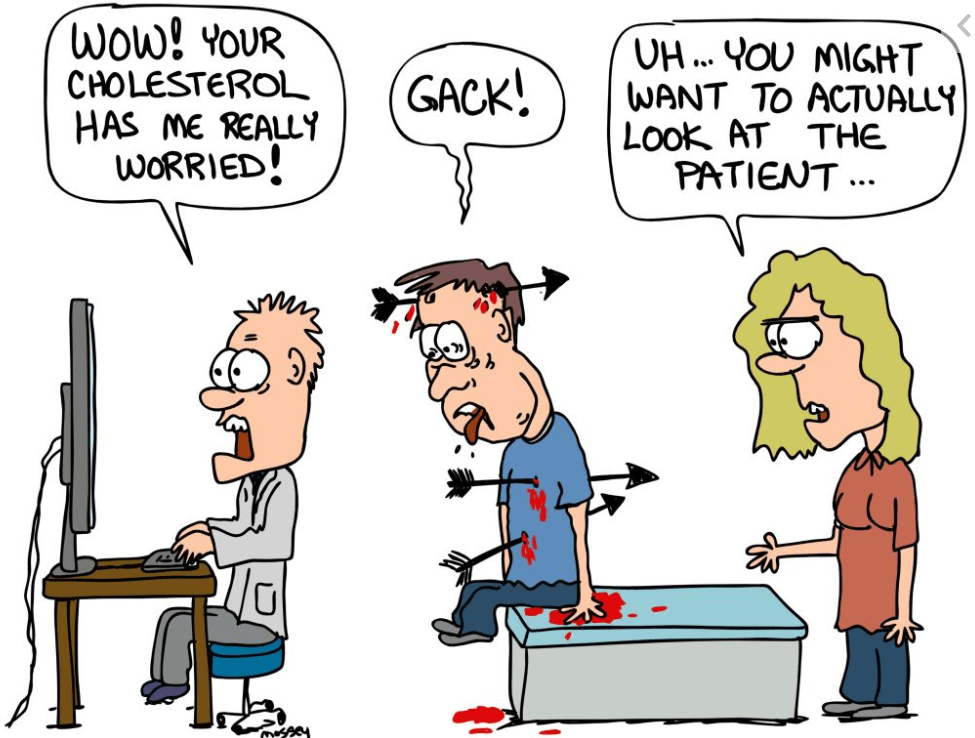
I am not talking about a marriage though that is worthy of another post given how our addiction to phones and apps prevents us from being present with the other person. This one’s about a patient-doctor relationship.

Source: fredericksburg.com; Dr. Steven Mussey

We all have probably visited a doctor and have noticed how much time the doctors seem to be spending on their electronic medical record system vs. having a real conversation with the patient. A study published in the Annals of Internal Medicine found that on average a physician spent 16 minutes and 14 seconds using the EHR (electronic health record) for each patient that he or she saw. And an average physician appointment is 15 minutes. Some parents have said that when kids draw their doctor, the ever present EMR always makes it into the picture. I am willing to wager that no doctor wants this but do it for many reasons including billing , documentation, liability etc. I cannot help but wonder if this is a case where the technology undermines the most important component of the interaction – a real dialog between the patient and the doctor? And do not even get me started on how difficult it is for me as a patient to get any of my records if I ever need it to get a second opinion or just keep it for reference (another post for another day).

Growing up in India, we had a family PCP – Dr. KV in Ashok Nagar. When any of us got sick such as a cold, fever etc, we went to the doctor’s office which was an independent practice. KV’s office was an examination room and a small waiting room with a long wooden bench. When we arrived there, a peon (office boy) gave us a ticket with a number and we sat on the bench to have our number called out. No preferential treatment for anyone, no appointments – you showed up, got the ticket, and waited your turn in the line till the peon called out your number. Each person gave their ticket back to the peon on their way out.

When you walked in, the doctor’s office had the bare minimum essentials. KV’s desk with two chairs and an examination table, and a sink to wash hands. No electronic medical records, no nurse hovering over you to take your temperature before the doctor sees you etc. KV looked at you, asked about your symptoms and did the examination, made a diagnosis, wrote a script (if that was the best action), or asked you to go for a lab test (if required). Majority of the patients walked out with a script (no e-script sent to the pharmacy). KV always asked if you had any questions, told how soon you should see relief etc. As a patient, you never felt hurried. As a patient, you felt you had 100% of KV’s attention. As a patient, the eye contact mattered and conveyed empathy. As a patient, you felt more confident that you will get better. He was an amazing diagnostician and it was bedside manner at its best. He never asked to hoard your blood test, x-rays etc. He saw it and gave it back to you for safe keeping. And the payment was cash and direct to Dr. KV and pretty nominal (120 rupees or $2 in today’s terms). He certainly did not have the office overhead with systems, backups, billing staff, mailing bills, insurance hassles etc.

On slow days, when I walked in, I saw KV reading an English novel but he immediately stashed it into the table draw when I walked in. He had an amazing memory and would inquire about my grandfather’s health, or family. I am sure there were instances where KV had to refer a patient to a major hospital or a specialist but a majority were run of the mill cases that needed immediate care and expert advise.

When I came to the US, I realized that immediate care meant ER since most doctors could not fit you in to their schedule. At least these days there is a proliferation of urgent care making the cost to the system better but I would not call it fast or easy for that matter. In my experience, a trip to urgent care takes a couple of hours at least. For the ER, it is closer to 6-8 hours.

Why does access to convenient low-cost but good healthcare with an amazing primary care doctor have to be this hard in a developed country such as US? I have thought about Dr. KV more than a hundred times any time I ponder this question.