I am not talking about a marriage though that is worthy of another post given how our addiction to phones and apps prevents us from being present with the other person. This one’s about a patient-doctor relationship.
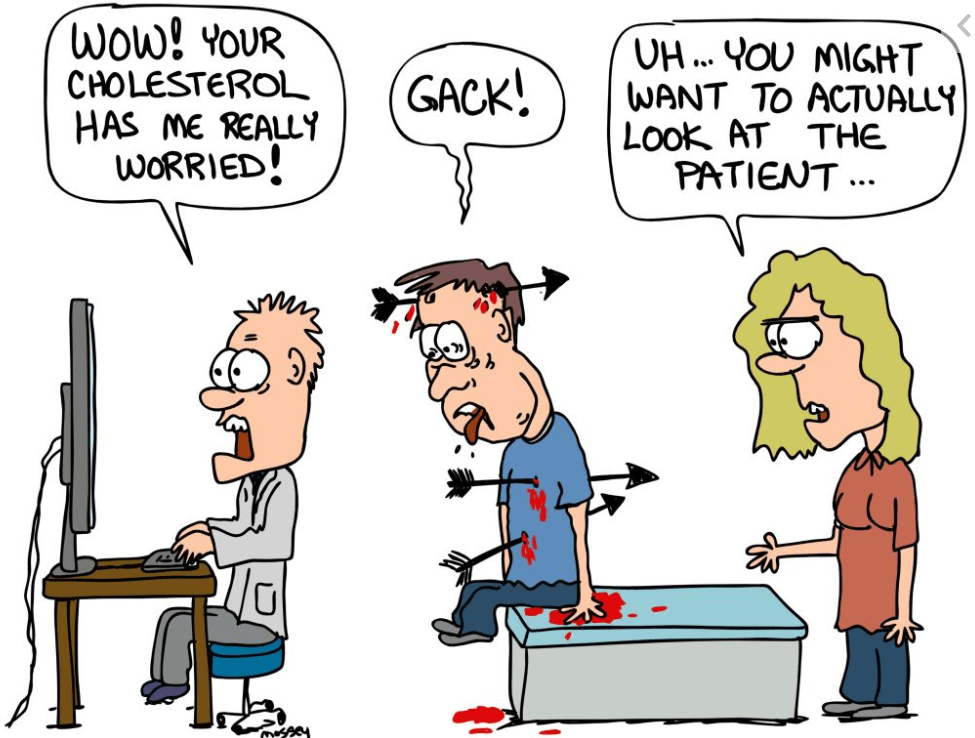
We all have probably visited a doctor and have noticed how much time the doctors seem to be spending on their electronic medical record system vs. having a real conversation with the patient. A study published in the Annals of Internal Medicine found that on average a physician spent 16 minutes and 14 seconds using the EHR (electronic health record) for each patient that he or she saw. And an average physician appointment is 15 minutes. Some parents have said that when kids draw their doctor, the ever present EMR always makes it into the picture. I am willing to wager that no doctor wants this but do it for many reasons including billing , documentation, liability etc. I cannot help but wonder if this is a case where the technology undermines the most important component of the interaction – a real dialog between the patient and the doctor? And do not even get me started on how difficult it is for me as a patient to get any of my records if I ever need it to get a second opinion or just keep it for reference (another post for another day).
Growing up in India, we had a family PCP – Dr. KV in Ashok Nagar. When any of us got sick such as a cold, fever etc, we went to the doctor’s office which was an independent practice. KV’s office was an examination room and a small waiting room with a long wooden bench. When we arrived there, a peon (office boy) gave us a ticket with a number and we sat on the bench to have our number called out. No preferential treatment for anyone, no appointments – you showed up, got the ticket, and waited your turn in the line till the peon called out your number. Each person gave their ticket back to the peon on their way out.
When you walked in, the doctor’s office had the bare minimum essentials. KV’s desk with two chairs and an examination table, and a sink to wash hands. No electronic medical records, no nurse hovering over you to take your temperature before the doctor sees you etc. KV looked at you, asked about your symptoms and did the examination, made a diagnosis, wrote a script (if that was the best action), or asked you to go for a lab test (if required). Majority of the patients walked out with a script (no e-script sent to the pharmacy). KV always asked if you had any questions, told how soon you should see relief etc. As a patient, you never felt hurried. As a patient, you felt you had 100% of KV’s attention. As a patient, the eye contact mattered and conveyed empathy. As a patient, you felt more confident that you will get better. He was an amazing diagnostician and it was bedside manner at its best. He never asked to hoard your blood test, x-rays etc. He saw it and gave it back to you for safe keeping. And the payment was cash and direct to Dr. KV and pretty nominal (120 rupees or $2 in today’s terms). He certainly did not have the office overhead with systems, backups, billing staff, mailing bills, insurance hassles etc.
On slow days, when I walked in, I saw KV reading an English novel but he immediately stashed it into the table draw when I walked in. He had an amazing memory and would inquire about my grandfather’s health, or family. I am sure there were instances where KV had to refer a patient to a major hospital or a specialist but a majority were run of the mill cases that needed immediate care and expert advise.
When I came to the US, I realized that immediate care meant ER since most doctors could not fit you in to their schedule. At least these days there is a proliferation of urgent care making the cost to the system better but I would not call it fast or easy for that matter. In my experience, a trip to urgent care takes a couple of hours at least. For the ER, it is closer to 6-8 hours.
Why does access to convenient low-cost but good healthcare with an amazing primary care doctor have to be this hard in a developed country such as US? I have thought about Dr. KV more than a hundred times any time I ponder this question.

 epiphanu